Firearms 101
An Online Preparatory
Firearm Education Course
This Page Last Updated 12/31/2014
Not an NRA Member? Shame on you!
We would not even be having this conversation
on the topic of gun rights in America if it wasn't for the hard work and
dedication of the National Rifle Association. You say that you don't have
the money??? An Associate Membership (no magazine) is just $10.00 per
year, that's less than three cents (-$0.03) each day. Before you do
anything else, do your duty and support the NRA through your membership. JOIN
THE NRA TODAY. You can save $10.00 on a regular annual membership by
using the link I've just provided, making it just $25.00. JOIN
TODAY.
Easy to use book marked links:
* Takes you to
another page.
Did you know that
you can give a loved one an NRA
Membership as a gift?
Go to my "NRA Membership" page to
learn more.
Or get out a credit card and go here
to do it right now!!
Welcome to Firearms 101, your, online Unofficial
Basic Firearms Education Course.
Thank you for visiting my online firearm education course. I am
a retired Certified Firearm Instructor and have quite a few years of teaching and
shooting experience.
Very soon, this page will contain all the information included in an
actual Basic Firearm Education Course. It will include digital photographs
and digital video to help you grasp and retain the various concepts of basic
firearm safety, knowledge, and operation.
The information I've provided for you is here to
enhance your learning experience. I only ask that you make
a voluntary contribution to my efforts to keep this public service free for
everyone.
This online, basic firearm education course is not intended to replace an
actual in-person course that you might take at your local gun club, from a
local police officer, law enforcement officer or through a Certified Firearm
Instructor.
Rather, this online course should be considered as a preparatory, first
look and rehearsal, to better equip you for your in-person course and the
curriculum that you will find there. This online course is designed and
intended to precede an actual course and prepare you for what you might encounter
there.
Most likely, the gun club, police officer and/or firearm instructor that
conducts your course will require you to sign a waiver of responsibility before
the course begins and this online preparatory course is no different in that
respect.
In order to participate in this online exposition, I too require that you
read and agree to my "Disclaimer" page,
before you continue beyond this point.
Basic Firearm Education
Preparatory Course
INTRODUCTION
Proper firearm education is the single most
important tool we can use to fight against gun control measures and to
drastically bring down the incidence of accidental discharges while
handling firearms.
It is abundantly clear, simply by reading through gun control bills that
are passed in Congress and in state legislatures around the United States, that
those who stand against the 2nd Amendment to the United States Constitution are
good people, who are trying to do something about violent crime. But that
they simply have no idea what they're doing.
I believe
that if everyone was familiar with firearms, how to handle them and was acquainted
with their capabilities and limitations, gun control would cease to exist as a
public policy. Accidental death rates involving firearms would drop so low, that they could
not even be given a legitimate category.
Accidental firearm discharges are currently at or near their all-time
lows, even though the number of firearms in the United States are at their
all-time highs and increasing by about 4.5 million each year. This is a
HUGE success and this is GREAT NEWS. As long as your not an hysterical
anti-gun zealot who is clinging to an intrinsic and unreasonable fear of
firearms, that is.
The unknown has always invoked a fearful response
from human beings. We have always had a fear of the unknown, it is a
completely natural physical response. I truly believe that most gun
control legislation gets its support from this pervasive ignorance of both firearms
and the honest men and women who own and carry them in public..
According to some historians, the first guns that
used gun powder to send projectiles happened during the Siege of Seville in the
year 1247. At this writing it's the year 2010. The first guns
were used seven hundred sixty three (763) years ago. When the gun was
first used in Europe, the majority of earth's inhabitants would think the planet
was flat as a pancake for another two hundred fifty (250) years. It's well
past time to get over our fear of firearms.
"It is the function of speech
to free men from the bondage of irrational fears."
Justice Louis D. Brandeis
(1856-1941) US Supreme Court Justice
Source: Whitney v. California, 1927
It's no wonder that most non-gun owners have an irrational fear of
firearms. Too often in the entertainment industry, firearms and their
capabilities are misrepresented. For instance, a .38 Special revolver shot
at a car will merely put a hole in the radiator and come to a stop once it hits
the engine block. This of course is not sensational enough for television.
However on television and in the movies you'll find the vehicle launches
ten feet into the air and lands in a shower of glass, flame and twisted
metal. That is not a truthful portrayal of a firearm's capability.
This widespread misrepresentation of firearms and their capabilities is an unconscionable
disservice to the general public. It makes for good entertainment, but not
good firearm education and gun safety training.
More often than not, if you look at movie posters and television
programming advertisements you'll see the star of the movie or program posing
with their finger on the trigger of a handgun. Take a look through the
latest magazine or television programming directory and I'll guarantee that
you'll find a photo of someone posing with a handgun with their finger resting
on the trigger. People who know firearms and good gun safety techniques
will never do that.
The widespread lack of knowledge concerning the
origins, operations, capabilities and limitations of firearms, has led to a
prevalent apprehensiveness and general fear of firearms. Similar to the fear of sailing off the edge of the
Earth, the general lack of knowledge concerning guns has likewise caused a
degree of dismay among the people. This fear of guns, inevitably leads to
animosity and even hatred of firearms and those who use them, legitimately or
otherwise.
I believe the anti-gunner begins with a total lack of knowledge about
firearms, lawful gun owners and how felons obtain their illegal guns. This lack of
knowledge, fed by the misrepresentation of firearms in the entertainment
industry feeds an irrational fear of guns. This irrational fear of guns
then leads into a hatred of guns and the law abiding gun owner.
Therefore, I believe that a full and proper
education in firearms is an essential ingredient in guaranteeing that the Second
Amendment will NEVER BE REPEALED.
On this page, I hope to show you the following:
- Basic safe gun handling rules.
- A little history about firearms.
- The reasons why we own guns.
- What a gun is and what it does.
- The three basic types of firearms.
- The various parts of those firearms.
- How to load and unload them.
- General firearm operation.
- The six fundamentals of aiming and firing a gun.
- General knowledge of ammunition and its
components.
- How to properly clean a firearm after using it.
As
I have stated above, this Web page is NOT a complete firearm education
course. Although I am an NRA Certified Firearm Safety Instructor, nothing can replace
the one on one attention and hands-on experience that you would receive from participating in an actual
firearm safety and education course.
Your ability to ask questions and have personal instruction from a Certified
Firearm Instructor or qualified Police Officer cannot be replaced by a textbook
or even an interactive Web page.
This is
not intended to be a replacement of an actual NRA Basic Firearm Safety and
Education Course.
Rather than a replacement, this page is
intended to be a sort of preparatory course taken in advance of an actual
in-person course taught by an experienced and fully qualified NRA Certified
Firearm Instructor.
The regular NRA Basic Firearm Education Courses can exceed one hundred dollars
($100.00) per course.
For this online preparatory course, I am providing it free of
charge. But I do gratefully accept contributions to keep me
going. See my "Contributions"
page for details.
Please take a
moment to review the Disclaimer page in the
navigation bar to your left. In order to continue with the Preparatory
Basic Firearm Education Course, you are bound by the contents, guidelines and
legal disclaimers set forth in my disclaimer
statements.
On this page, I will tell you about different types of guns, their parts and
generally how they work. You will also learn how to shoot and about
ammunition and
how it works as well as a little about how to clean a gun when your finished.
More
important than the mechanics of gun safety and handling is the proper attitude
that is so necessary to a lifetime of safe firearm ownership. A proper
attitude toward gun safety is equally as important as knowing all the
rules.
You can contact
the National Rifle Association from this Web
site or contact your local gun club
for an actual gun safety and marksmanship course. (Click on
"Programs" and then "Firearm Training")
Safety First
Please take time to read my "Safety
Rules" page. Gun safety is my primary concern. I started by
teaching kids about gun safety when I was just 21 years old. Please also
find time to check out my "For Kids Only"
page, which may be the best gun safety page for kids found anywhere on the
Internet.
I
will not recreate my "Safety Rules"
page and my "For Kids Only" pages
here. It would take you hours upon hours to go through those two pages and
this one too. However, viewing or reviewing those pages is a very
important aspect of this online course. In order to consider this online
course completed, one must review and absorb those two pages.
There are only two (2) primary causes
of accidental discharges that may result in personal injury or death.
-
Carelessness-
Carelessness
simply means that the person handling the gun has a general knowledge of gun
handling rules and safety, but refuses to obey them for some bizarre reason.
Usually carelessness that results in needless injury or death is due
to the VERY inadvisable use of alcohol and/or narcotics that alter
the brain's functions. A proper attitude toward gun safety is essential to overcome any
degree of carelessness.
Basic Gun Handling
Rules
There are only three (3) basic gun
handling rules: They are listed here in order of importance.
-
ALWAYS point the
barrel of the gun in a safe direction. A safe direction is defined as
a direction where if the gun discharged, nobody would get hurt. The
best direction to point a gun is generally at the ground or floor and to the
side.
This is the Golden Rule Of
Gun Safety.
If everyone followed this one rule, it would bring an end
to accidental firearm related deaths.
Be aware that the "safe direction" may change as you
change your location and environment.
-
ALWAYS keep your
finger off the trigger until you are ready to fire. There is a natural
tendency to place the index finger inside the trigger guard. This MUST
be avoided. Condition yourself to place your shooting hand index
finger along the side of the frame.
There is no reason whatsoever that your finger should be on
the trigger unless you have safely and appropriately
acquired your target and your sight picture and are ready
for the trigger squeeze.
-
ALWAYS Keep the
action open and the gun unloaded until you are ready to use it. The
action is the moving parts of the gun that allow loading, unloading, firing
and extraction of the empty case or shell. If you are not ready to use
it, keep the action open and unloaded.
With an open and unloaded action, the only injury that
might occur, is if you drop the firearm on your foot.
A
Proper Attitude
A proper attitude toward gun safety is just as important
as applying the three basic rules of safe gun handling and
obeying all of my listed gun safety
rules.
A proper attitude toward gun safety is simply accepting
the responsibility as a gun owner to act safely around
firearms at all times and under all circumstances.
I know I am repeating myself, but the proper attitude cannot be
overstressed. If I was teaching you in person, I could better demonstrate
a proper gun safety attitude, but here, it is difficult, so I have taken the
liberty to repeat myself.
I have written a page of
gun safety rules as well. The page is called "Safety
Rules" and it's one of the most comprehensive list of gun safety rules
found anywhere in the world. I encourage you to read that page thoroughly
as well.
Establishing a proper gun
safety attitude and engraving firearm handling rules and other gun safety rules
into your mind and the minds of your family will ensure that you and your family
can peacefully and safely coexist with firearms for the rest of your natural
lives.
The First Guns
The first recorded recipes for making
gunpowder came from China. The first reference of
gunpowder is possibly the passage of the Zhenyuan miaodao yaolüe, a
Taoist text tentatively dated to the mid-800s. Most historians agree that
gunpowder first originated between the year 850 and 900.
(see http://en.wikipedia.org/wiki/Gunpowder)
A Chinese alchemical text dated 492 A.D. noted saltpeter burnt with a purple flame, providing a practical and reliable means of distinguishing it from other inorganic salts, thus enabling alchemists to evaluate and compare purification techniques.
Source:
Chase, Kenneth (2003), Firearms: A Global History to 1700, Cambridge University Press, ISBN 0521822742.
According to some historians, the first
guns that used gun powder to send projectiles happened during the Siege of
Seville in the year 1247. At this writing it's the year 2010.
The first guns were used as early as seven hundred sixty three (763) years ago.
When
the gun was first used in Europe, the majority of earth's inhabitants would
think the planet was flat as a pancake for another two hundred fifty (250)
years. It's well past time to get over our irrational fear of firearms.
According to other historians,
hand-cannons were first used at the Battle of Ain Jalut in the year
1260. So whether it was the Siege of Seville in 1247 or Battle
of Ain Jalut in the year 1260, the fact remains that guns are not new to the
human race.
The Chinese were firing sticks and stones from bamboo poles with gunpowder, many
years before the year 1200, so it is assumed that the Chinese were first to invent
them. These poles were called Fire Lances. The fire lance was
packed tightly with gunpowder and fired by a burning ember in the rear of the
pole. The fire lance was initially used to scare horses and men in battle.
Then they began to pack the fire lances with projectiles like stones and
sticks and sometimes arrows. They changed the recipe for gun powder by
adding more nitrates to the mixture, making it burn quicker and more
powerfully. Then they shortened the fire lances and improved the
projectiles and began using forged metallic balls and the firearm was born.
Fire lances were initially fired by three people, then two person teams
and finally were able to be controlled by a single man. They were still
fired by burning embers or coals and then fuses. The term 'firearm' came
from the fact that one of the shooter's hands had the fire, while the other
controlled the gun. It was a variation of the term 'bow arm' that is used
in archery to this day.
However, the first inventor was never recorded, or if it was, it has since
been lost over the last 800+ years. So we do not actually know the
inventor of the gun. We do not even know when the fire lance officially
became the firearm. But we can guess that it was likely in China between
the years 1160 and 1240.
The first guns were called "hand cannons" and were fired
by hot coals or burning embers.

This is an example of a "hand cannon" from the late 1300's.
This hand cannon was discovered buried near the Tongjimen area of Nanjing in
China and was dated to the year 1373 by historians and markings. They were
not referred to as "handguns" until at least the year 1388.
These guns were fired basically the very same way that they operate today.
A gunpowder charge was loaded into a tube, then on top of that was placed
a projectile, like a stone or forged metal bullet. The gunpowder was then
ignited behind the projectile. The quickly burning powder in a very small area, created a vast
amount of expanding hot gas that pushed the projectile down the tube at high
speed.
Today's modern guns fire in generally the same manner. Of course the
use of modern materials and manufacturing techniques have made the gun powder
and projectile interaction, much more efficient and accurate. Today's
fastest bullets can go a mile in less than two seconds.
Why Do We Own Guns?
Why do we own firearms? The majority of law-abiding gun owners own
their guns for recreational target shooting and hunting. Many people shoot
competitively in local gun clubs. Many clubs have shooting teams that compete with other gun clubs.
The
ultimate in competitive shooting is the National Championships and of course to
shoot with the United States Olympic Shooting Team.
The hobby of
collecting firearms is also very popular. Many people collect antique
guns or guns owned by famous people. Some collectable firearms have values
that exceed $20,000 to $40,000 each.
Finally there is a large segment of the population that is concerned for their safety, the safety of
their families and the protection of their businesses and livelihoods.
Personal protection is a basic human right. It would be unconstitutional to be denied the right of self protection.
Most gun owners in the United States acknowledge a willingness to utilize a
firearm to protect their families from harm if necessary.
It has been reliably estimated that firearms are used for the protection
of innocent people, families and businesses above two million times a
year. That is over 5000 times a day!!! Over 90% of the time however,
the gun is never fired and in many instances self defense uses of firearms go unreported.
I
believe that the single most important aspect of the right to keep and bear arms
is that private firearm ownership is a final check and balance on the scope of
government power. An armed citizenry will always keep tyranny and
dictatorship at bay. For a tyrannical power to take hold in any country,
the people of that country must first be disarmed, this is common sense, and has
been proven throughout history many times.
"A people armed and free
forms a barrier against the enterprises of ambition and is a bulwark for
the nation against foreign invasion and domestic oppression."
James Madison (1751-1836),
Father of the Constitution for the USA, 4th US President
The Founding Fathers did not include the Second Amendment in the Bill of
Rights to protect the hunting tradition. The Second Amendment's right to
keep and bear arms has nothing whatsoever to do with hunting at all.
Rather, the Second Amendment was intended to be a final and last resort to ward
off tyranny.
"God forbid we
should ever be twenty years without such a rebellion.... And what country can
preserve its liberties, if its rulers are not warned from time to time, that
this people preserve the spirit of resistance? Let them take arms.... The tree
of liberty must be refreshed from time to time with the blood of patriots and
tyrants."
Thomas Jefferson, in letter to
William S. Smith, 1787
What Is A Gun?
A gun is merely a mechanical device that is used to store, aim and
discharge ammunition. It allows the propelling of a small piece of metal, at a very
high speed, in a generally straight line, minus gravity of
course. A gun cannot fire by itself without human interaction. A
gun is merely a tool in the hands of a user. Firearms have no spirit, no will and
are certainly not the evil menace that the media and the
anti-gun Democrats and even some uninitiated Republicans have portrayed them to
be.
Any firearm will ONLY do what
the user makes it do. There MUST be human interaction.
Millions of people have a fear of
guns because they don't have a clue about how they work or what their
capabilities and limitations are.
This fear of
guns is the only thing that
gun control activists have as a weapon on their side.
Placing blame on firearms for the
uncivil, illegal and immoral actions of habitually violent criminals is inane,
absurd and actually quite silly. Bad people who should be in prison often,
but not always choose firearms to commit crimes with.
99.8% of all
firearms are not used in crime in any given year.
Likewise, 99.6% of handguns alone, are not used in crime
in any given year.
Law abiding and honest gun owners
do not commit any crimes. But most gun control laws have to be obeyed by
these decent and upstanding men and women. That's unfair, unconstitutional
and an extremely ineffective method at controlling acts of violent crime.
Firearm Types
There are hundreds of types of firearms that are available, but there are only
three major categories.
All firearms consist of three (3) major parts:
- Frame or Stock- The frame is the basic structure of the gun to which the
other major parts are attached. The stock is for rifles and
shotguns. Handguns don't have a stock, but rather what is called a
grip. Please do not call the grip a 'handle'. :-)
- Barrel- The barrel is the long hollow tube through which the bullet
travels on its way to the target.
- Action- The action of the gun consists of all the moving parts that
facilitate the loading, firing, discharging of the empty case and unloading of the gun.
SHOTGUN
A shotgun is operated with two hands and is shot from the shoulder. It
is designed to shoot a shell which consists of pellets of various sizes.
The size of the pellet depends on what it is going to be used for. Larger
size pellets could be for hunting big game such as deer. Smaller pellets
are used mainly for birds or rabbits. A shotgun can
also shoot a single large bullet called a slug which can weigh an ounce or more.
I speak more about shotgun ammunition a bit later.
RIFLE
A rifle is also operated with two hands and is shot from the shoulder.
It is designed to shoot a single bullet at a time. The main difference
between a shotgun and a rifle is the ammunition it shoots. The shotgun
ammunition is called a shell. The rifle ammunition is called a
cartridge. Another difference between the two is that the inside of the
rifle barrel has spiraled grooves cut into it that imparts a spin to the bullet
before it exits the barrel, much like a quarterback will put a spin on a
football to make it fly straight. Some shotgun barrels that are
designed to shoot slugs are also cut with grooves in it to make the slug spin
in the air, stabilizing its flight path.
HANDGUN
The term "handgun" was first used in the
year 1388. Before that, as we have already learned, they were called
"handcannons".
A handgun can be operated with one hand, although in most target shooting and
all self defense shooting, two hands should be used.
The inside of the handgun
barrel is also cut with grooves. These grooves are also called rifling.
Rifling is made up of lands and grooves in the surface of the barrel. When
caliber is measured on a rifled barrel, it is measured from land to land and not
from inside the grooves.
Firearm Action Types
There are many, many different configurations, actions, safeties and calibers
of firearms. I will not discuss them all. Instead I will simply
highlight a few of the more popular ones. If I went through every type of
action, we'd be here all day.
(>>>Remember: The action is all the moving parts of the firearm
that allow the loading, firing and unloading of the
ammunition.<<<)
Pump Shotgun- This shotgun is very popular. It chambers a shell with
the cycling of the forearm of the gun in most models, and requires the
shooter to "pump" the forearm to eject a used shell and chamber a
fresh one.
Semi-Automatic Shotgun- This shotgun is also very popular. With this
firearm the shooter fills a spring-loaded magazine of various type and manually chambers a
shell. When the first shell is fired, some of the pressure created
from the shell is used to cycle the action, thereby ejecting the used shell
and chambering a fresh one automatically.
The shooter must pull the trigger
one time for firing every shell.
Bolt Action Rifle- This rifle works very similar to the pump shotgun but
it uses side mounted device to extract the used cartridge and chamber a
fresh one.
PLEASE
READ THIS
Please take note of the following images and the different parts of the various
firearms. This information will help prepare you for your actual gun
safety course.
Much of your classroom time will be learning the different parts of firearms,
how they work, what they do and the loading and unloading procedures of each.
Please make certain that your Certified Firearm Instructor or Police Officer is using
"dummy" ammunition for the loading and unloading procedures in the
classroom.
If your classroom instructor is using live ammunition for this demonstration,
he/she is violating the Instructor's Creed and he/she should be firmly
rebuked for such action.
Live ammunition should not be used until all classroom activity has been
completed and you are at the range for your required range work.
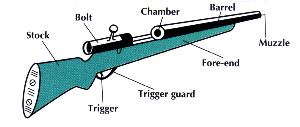
Please take note of the different parts
and their names. The rifle in this image has a bolt-action.
Bolt
Action Rifle- The above rifle is a
bolt-action rifle. The action is cycled through the use of the protruding
handle on the top of the bolt in the image.
Semi-Automatic Rifle- This type of rifle was invented in 1890.
It uses the same principle as the shotgun mentioned above and also needs
human interaction for each and every shot. The semi-automatic rifle
requires a trigger pull for each shot. This is not an "Assault
Rifle". Technically, an "Assault Rifle" is a fully
automatic machine gun.
See
this great video YouTube on the truth about semi-automatic firearms.
Machine Gun- This firearm has been heavily restricted
and taxed since the
National Firearms Act of 1934. The general public are for all intents
and purposes not allowed to own this type of firearm without jumping through
hoops and dodging miles of red tape, registration schemes, taxes and
fees. This firearm will fire and reload itself as long as the
trigger is pulled and until the magazine is empty of cartridges. See
this video of a machine pistol. A fully automatic handgun.
Revolver- This type of handgun uses a round cylinder with holes punched in
it that are designed to hold the cartridges. The cylinder revolves to
bring a fresh cartridge under the firing pin.
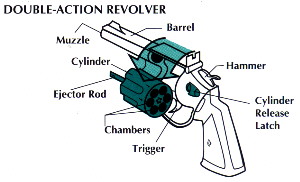
Please take note of the different parts
and their names.
Semi-Automatic Pistol- This type of handgun uses a magazine feeding device
and will fire and eject a cartridge with each pull of the trigger by the
user and was first invented in the year 1895.
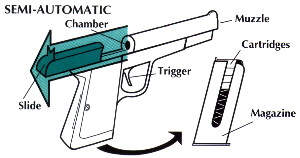
Please take note of the different parts
and their names.
Actions continued...
There are many types of actions. The action is
the moving parts of the gun that allow loading, firing and unloading of the
gun.
In a single-action gun, the trigger performs a single
action, the releasing of the hammer, which makes contact with the firing
pin, which discharges the primer, which ignites the powder charge.
See
this video to better understand the firing sequence.
In a double-action
gun, the trigger can both cock the hammer and fire the cartridge, performing
two actions. There is also a "double-action only" type of action where
the trigger both cocks the hammer and fires the cartridge with every pull. In a
double-action only handgun, there is usually no external hammer spur that
the shooter can pull back to cock the gun.
In a semi-automatic pistol, single-action and
double-action refer to the first shot only. After the first shot, the
recoiling slide cocks the hammer. In a "double-action only"
semi-automatic, the slide does not cock the hammer, the trigger performs
this function.
There are many types of rifle and shotgun actions such as bolt-action,
lever action, semi-automatic, full-automatic, top break (hinge), pump action,
falling block and rolling block.
If you are still confused about the actions in different
types of guns, use the feedback form on the "Ask
Marc" page and ask away.
Your
Certified Firearm Instructor will fully explain these action issues. It is
essential that you are comfortable with this information. If you have
remaining questions, don't head out to the range until you completely understand
what you will be asked to do.
Loading/Unloading
Loading and unloading procedures can vary somewhat from model to
model, however in general there are certain procedures that should be
followed:
-
The third step depends on the type of gun being used.
In a revolver, just flip out the cylinder with the cylinder release latch and
using your middle finger and ring finger.
Then insert the cartridges into the cylinder to load. To unload, dump the
ammo or empty cases into your hand by tipping the gun
up and pushing the ejector rod on the front of the
cylinder. Watch out
for that muzzle, be aware of where you are
pointing that barrel. If the revolver is a single
action revolver, there will be a loading/unloading port on the right side of
the cylinder, through which the cartridges or cases and inserted or
extracted.
It is important to
note here that many accidental deaths have occurred because of faulty loading
and unloading
procedures.
To unload the semi-automatic, remove the magazine first.
After removing the magazine, cycle the action
by pulling back the slide and catch
the ejected cartridge in your hand.
Note:
IF YOU REVERSE THE
TWO STEPS ABOVE, YOU WILL STILL HAVE A LOADED FIREARM!!!
Keep that finger off the
trigger throughout the entire process!!!
To load the semi-automatic, insert the cartridges into the
magazine, insert the magazine into the grip of the handgun and then retract and
release the slide to load the chamber.
The semi-automatic rifle with removable magazine loads the
very same way.
With a rifle containing a non-removable magazine, you should hold
the barrel in a safe direction, keep your finger off the trigger, engage any safeties
that are present and cycle the action until the firearm is empty to unload it. Loading
procedures can vary greatly between models. Please make sure you
follow the manual's instructions.
It is of paramount
importance that you condition yourself to place your finger along the frame of
the gun during loading and unloading. There is a natural tendency to place the index
finger inside the trigger guard. This tendency MUST be avoided.
Classroom Practice
You should be given ample time to
practice the loading and unloading procedures for different types of firearms
while in the classroom, using inert dummy ammunition cartridges without primers
or gunpowder.
It is very important that you are
familiar with these procedures before you head to the range. You DO NOT
want to be learning how to load and unload firearms safely using REAL ammunition
cartridges.
Don't allow your
instructor to bring
you out to the range with live ammunition until you are comfortable with the
loading and unloading procedures that you will be asked to perform on the firing
range.
Practicing loading and unloading
procedures under close supervision, with inert or "dummy" ammunition
is an important aspect of the classroom work.
You should make sure that you have
ample opportunity to try out the loading and unloading procedures for each type
of firearm that is present until you are comfortable that you can do it
correctly with live ammunition on the range.
Ammunition Knowledge
Ammunition comes in countless varieties.
It can be either a shotgun shell, a rifle cartridge
or a handgun cartridge. Sometimes ammunition is erroneously called
"bullets". A bullet is just one of the components of a
cartridge. There are two types of cartridges, they can be either centerfire or rimfire.
This
depends on the location of the primer. In a centerfire cartridge, the
primer is located in the center of the base. In a rimfire cartridge,
the primer is located in the rim around the base of the case.
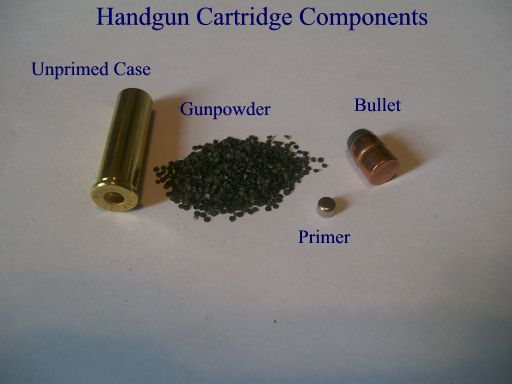
There are four (4) components to a cartridge.
-
The case is the major part of the cartridge and contains the
other three and is mostly made from brass. Some manufacturers use an
aluminum alloy.
-
The primer is located in the bottom of the cartridge and is
used to ignite the powder.
-
The powder is contained within the case.
-
The bullet is seated in the mouth of the case.
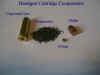
Click on this image
above for a better look at ammunition
components.
Caliber and Gauge
Caliber or gauge is a measurement of
the projectile and barrel diameter. Normally ammunition is intended for a specific caliber of
firearm. Firing ammunition of a different caliber or gauge in a firearm
can be very dangerous and can cause serious injury or death. There are
some ammunition calibers that can be safely fired in other calibers, but you
have to be very careful that they are compatible. One instance that
quickly comes to mind is that a .38 Special cartridge can be safely fired from a
.357 Magnum revolver.
The caliber or gauge of a gun is
usually stamped on the gun's barrel and on the bottom of the cartridge's case or
shell.
Ammunition is designated
as either caliber or gauge. A
cartridge's caliber is designated in hundredths of an inch, thousandths of an inch or
in millimeters. The caliber is measured across the bottom or base of
the bullet.
Shotgun ammunition is designated in gauge. Here is how
the gauge designation works:
If one takes a full pound of lead and forms the lead into 12
perfectly round balls. One of those balls is said to be 12 gauge and
would fit into a 12 gauge barrel. Another way to explain it is that
the gauge of a shotgun is the number of spheres (balls) of lead, made to fit the
barrel of the shotgun, that total one pound in weight.
Therefore, the higher the gauge
designation is,
the smaller in diameter the barrel is. There is also a shotgun that is
designated in thousandths of an inch and that is the .410 gauge shotgun.
The .410 gauge shotgun is the smallest shotgun available.
A 10 gauge shotgun shoots a very large projectile, because
each round projectile would weigh 1/10th of a pound. A 28
gauge shotgun is quite a bit smaller in diameter, because a round ball that just
fits down the barrel is 1/28th of a pound.
Shotgun Shell
A shotgun shell consists of a plastic hull with a metallic
bottom. In the metallic bottom of the shell is a primer which is used to ignite
the powder. After the powder is a wad and after the wad is the pellets
of lead or steel.
The shotgun shell consists of five (5) different parts:
-
Case or Hull The case
is the plastic hull that contains all other components.
-
Primer The
primer is in the metallic base of the shot shell and is designed to ignite
the powder charge within the hull.
-
Powder Charge The
gunpowder charge goes into the primed case first. It is designed to
burn up very, very quickly.
-
Wad The
wad is usually plastic and it designed to protect the pellets until they
leave the barrel and to ensure that the propellant forces the shot down the
barrel efficiently.
-
Shot Pellets or Slug This
of course is the lead or steel shot that is forced down and out the barrel
at very high speed.

Firing Sequence
When a cartridge is fired, the firing pin from the firearm
hits the primer with enough force to ignite it.
The flame created by
the primer goes through the bottom of the case in a hole called the
"flash hole".
The flame then ignites the powder within the
case or hull.
The powder then burns almost instantly creating a
tremendous amount
of pressure inside the case. The bullet then moves VERY quickly
down the barrel.
See
this video to better understand
the firing sequence. The pressure within the case at this point
can reach more than 20 tons per square inch. This colossal amount of
pressure forces the bullet out of the case and down the barrel at very high
velocity. Some bullets can travel a whole mile in less than two (2) seconds.
WOW!!
The bullet can then fly as much as five (5) miles away depending on
the caliber, bullet and powder used in addition to the elevation at which
the gun is fired. WOW!! It is important to note that
the ammunition does not explode under normal circumstances. The massive pressure that is
created by the firing of the cartridge is used to propel the bullet.
Ammunition purchased at a retail outlet is normally very safe.
There is no explosion, only because the lead or steel
projectile is moved down and out the barrel using the tremendous amount of
pressure and hot gas. If the bullet were to be welded into
the case, or the bullet was immovable, the cartridge would then explode.
Shooting Basics
The actual shooting of a gun at a
target seems like a very simple act in the movies or on television dramas.
However, in real target shooting, there
are six (6) basic fundamentals to keep in mind during shooting.
-
Body Position
-
Grip
-
Sight Alignment
-
Breath Control
-
Trigger Squeeze
-
Follow Through
Body Position-
Body position is the first basic I will
discuss. Be sure to keep your feet about shoulder width apart for
stability. You may want to shift some of your weight to the balls of your
feet and not your heels. Choose whether you are going to try a one-hand
position, two-hand position or a bench rest position.
Assume a comfortable and relaxed
position. Align your body with the target. Many people think they
should force the gun to the target, but it is much better to have your body in
the proper position before taking aim.
Try this:
Take an empty gun and assume a firing
position. Align your gun with the target. Then close your eyes for
30 seconds. Now take a look at where your gun is on the target.
Chances are good that it moved. Now adjust your body position back to the
target, by moving your feet. Now try it again until your body is pointing
quite naturally at the target.
Grip- Taking
a proper grip and maintaining that same grip throughout your firing is an
essential ingredient to consistency. Place the handgun in your shooting
hand with your non-shooting hand. Push the gun into the V created by your
thumb and index finger. Keep the shooting hand as high on the backstrap as
possible. When cocking a hammer, use the non-shooting hand thumb, because
it will disturb your grip otherwise. Keep your non-shooting hand wrapped
around your shooting hand and clamp your non-shooting thumb down on your
shooting hand thumb. Consistency is essential here because if you change
your grip, your bullet placement will not be uniform.
Sight Alignment-
The central aspect of aiming is proper sight
alignment. Sight alignment is the relationship between four (4)
things. Your eyes, the rear sight, the front sight and your target.
Center the front sight into the notch of the rear sight and align the top of the
front sight with the top of the rear sight. Next, align the "sight
picture" with your target. Maintaining this sight alignment or
"sight picture" while pulling the trigger is the key to a proper shot.
For a look at sight alignment, check
out this page.
Breath Control-
Breath control seems like it won't matter that
much. And it really won't matter until you have a shooting contest with a
buddy and he is three points ahead of you!!!
Controlling your breathing minimizes
your body movement during sight alignment. As you breathe, your body rises
and falls with each breath.
You should take a normal breath, then
exhale slowly, just as your lungs empty is the best time to take your
shot. Try to take your shot within 5 to 8 seconds. Any longer than 8
seconds and more body tremors may be introduced due to oxygen deprivation.
Trigger Squeeze-
Trigger squeeze, trigger pull and trigger control
essentially all mean the same thing. It is the smooth and consistent pull
on the trigger while maintaining proper sight alignment. Nobody knows
exactly when the trigger will "break" and make the hammer fall.
Even after years of practice with the same gun, it will still be a surprise,
although after much practice, you can get a "feel" for when it might
go. If you feel that the sights are aligned on the target as you would
like, then squeeze a bit harder. However, if the sight alignment swings
off the intended target, you should lighten up a bit on the trigger.
Nobody, no matter how good they think they are can maintain perfect sight
alignment all the time. It is not physically possible. Practice,
practice and practice.
Follow Through-
Follow through??? What is follow through???
Follow through can be compared to a
bowler when throwing a ball down the alley, the bowler's arm continues through
the throw.
Or to a pool player, when he strokes
the cue ball, the tip of the cue goes right through where the cue ball used to
be.
Follow through in shooting is somewhat
similar. In follow through, you want to maintain the proper body position,
grip and sight alignment until after the shot has left the barrel.
This follow through helps to make sure
that the trajectory of the bullet is not affected by any extra movement on your
part which might affect the path of the bullet.
In pool, if the shooter stands up too
quickly after taking his shot, it might affect where the tip hits the cue
ball. In pool, shooters maintain that post-stroke position for a moment
until they make certain the cue ball is on its way. It is precisely the
same principle for shooting a gun.
Help, My Gun Is Jammed!!
Inevitably, everyone who regularly
fires a gun will run into a jam or malfunction at some point.
Many, many accidents occur while
attempting to clear a jammed firearm.
It is essential to review and follow
all three (3) safe gun handling rules first.
ALWAYS
point the barrel of the gun in a safe direction.
A safe direction is defined as a direction where if the gun discharged, nobody
would get hurt. The best direction to point a gun is generally at the
ground and to the side. This is the Golden Rule of Gun Safety. If everyone
followed this one rule, it would bring an end to accidental firearm related
deaths.
ALWAYS
keep your finger off the trigger until you are ready to fire.
There is a natural tendency to place the index finger inside the trigger guard.
This MUST be avoided. Condition yourself to place your shooting hand index
finger along the side of the frame.
ALWAYS
keep the action open and the gun unloaded until you are ready to use it.
The action is the moving parts of the gun that allow loading, unloading, firing
and extraction of the empty case or shell. If you are not ready to use it,
keep the action open and unloaded.
If the jam is in a semi-automatic pistol or rifle (which are
most common), follow the above gun handling rules, put on the safety catch,
button or lever, then
remove the magazine if possible, now open the action and lock it open. Now
you can safely work on the jam from here. The chances are good that
removing the magazine and retracting the slide will fix the jam in most cases.
If you have a case that is seated too deeply in the chamber
so that the extractor does not grab it, you should follow all the above
procedures, then gently pry out the offending case with a miniature screwdriver or some
such device being careful not to damage the loading ramp or the breech face.
Reloading
Reloading ammunition is an enjoyable hobby. It can really
be rewarding too. The money saved by reloading your own ammunition can be
substantial.
I will not even attempt to show the reader how to reload their
own ammunition here. But I will say a few things about it.
One can only reload
centerfire
ammunition. The .22 caliber
rimfire ammunition cannot safely be reloaded.
There are hundreds of different cases. Each one has an
identifying stamp on the bottom, with the caliber of the cartridge. If
there is no caliber stamped on the bottom of the case, that means that the case
originated from the military or a foreign country. Be careful when using
cartridges with no caliber head stamp.
There are over a hundred different smokeless powders that are
available to the reloader. Each and every one will burn at a different
rate. Single base powders are made primarily from nitrocellulose.
Double base powders are made with both nitrocellulose and nitroglycerin.
There many types of powder also, such as tubular, ball and flake.
Powder and bullets are weighed using a measurement called
grains. There are 6985 grains in one pound. Some people round this
number off and say that there are 7000 grains to the pound.
Grains are used to measure the weight of both the
powder charge and the bullet.
A normal powder charge can vary from two or three grains up
to 50 or more.
Some pistol ammunition powder
charges can be three (3) grains or maybe a bit less and rifle cartridges can use
more than fifty (50) grains.
A normal bullet weight can vary from 40 grains in a .22
Long Rifle to over 500 grains in a big game rifle.
There are also many different bullet styles and weights that one
can use for each caliber. For each different bullet weight, the amount of
powder to use can change slightly.
There are more than a dozen different types of primers too!!
Make no mistake about
this fact:
If a cartridge is loaded
improperly, with the wrong case, powder, bullet, primer combination, instant
death can occur.
It is absolutely
essential that if you choose to reload your own cartridges, you follow the prescribed ammunition tables for weights
and amounts.
Make sure that when you
reload, you stay as organized as possible and tenaciously stick to the
prescribed procedures. Experimenting with reloads can be deadly if you
don't know what you are doing.
Never allow yourself
to become distracted or disoriented when reloading your own ammunition.
Cleaning Your Guns
Regular cleaning is important in order for your gun to operate correctly
and safely. Taking proper care of it will also maintain its value and extend its
life. Your gun should be cleaned after every outing.
A gun brought out of prolonged storage should also be cleaned before
shooting. Accumulated moisture and dirt, or solidified grease, burnt powder
residue and oil, can prevent the gun from operating properly.
Before cleaning your gun, make
absolutely sure that it is unloaded.
The gun's action should be open
during the cleaning process. Also be sure that no ammunition is present.
There are many manufacturers of firearm cleaning kits and
they are sold in most department stores and sporting goods stores. Follow
the directions for cleaning that are specific to your particular model of
firearm and the directions from the cleaning kit that you have chosen.
If possible, clean the gun's barrel from the rear to prevent
any damage to the muzzle end of the barrel. Damage to the muzzle end of
the barrel can affect accuracy.
Generally, the first step is to put cleaning solvent on a
brush and plunge it in and out of the gun's barrel as many as 5 to 10
strokes. Once all the stubborn fouling is out, follow up with a few cotton
patches soaked in solvent until they begin to become noticeably less
dirty. Next, follow up with a clean patch, then an oiled patch.
After the barrel is cleaned and oiled, you should follow that
with another solvent soaked patch on the surfaces of the firearm, cleaning up
all the fouling around the breech or cylinder. Follow that with a clean
patch, then an oiled one. You may use an oiled patch on the exterior of
your firearm or you may choose a silicone impregnated cloth.
In a semi-automatic, it is important that the feeding ramp be
kept clean, along with the extractor and bolt face. Occasionally, you may
want to take the firearm apart for a more thorough cleaning. I think that
taking your firearm apart for a proper cleaning should be done at least once a
year.
A mistake that many beginners make is that they try to take
their gun apart too far. If you disassemble the gun to clean it, make sure
you follow the directions in the manual. If you take the gun apart too
far, only an expert may be able to reassemble it.
See
this video for a quick
once-over on cleaning
a pistol.
Any questions?
Ask Marc
A Big Thank You
I want to take this opportunity to
thank you for taking this Basic Firearm Safety and Education Course.
Remember, this course is only designed
to help prepare you for an actual in-person course and is not designed to
replace such a course.
An actual Basic Firearm Education
Course is designed to take at least eight (8) hours to complete, including at
least a few hours of actual "on the range" gun handling and actual
target shooting.
Please consider sending me a quick note
on how I can improve this page.
While you are mailing me a letter, why
not include a few dollars to help me out?
If you are writing a check, please make
it payable to Marc Richardson and not SaveTheGuns.com.
mail
to:
Marc H. Richardson
P.O. Box 424
Shapleigh, ME 04076-0424
or go directly to my Contributions
page.
Back To The Top.
|